Showing posts with label 10 of 10. Show all posts

Thursday, April 9, 2015

Literature Review: Ozymandias (1818)

Just wanted to mention that this blog has reached the six month mark!  Woo hoo!

On the subject of time, in the annals of literature in the English language, few masterworks are as eloquent or as memorable as the sonnet Ozymandias by the great Romantic poet Percy Bysshe Shelley:

Look on my works, ye Mighty, and despair!

Although perhaps overshadowed in the minds of modern audiences by his second wife Mary Shelley, the author of Frankenstein, Percy Bysshe Shelley is considered one of the greatest lyric poets of all time, despite his tragic death in a boating accident before his 30th birthday.  And he shows why in Ozymandias.

In a friendly competition with Horace Smith, a member of Shelley's literary circle, both men produced poems named Ozymandias about Ramesses II, widely regarded as the greatest and most celebrated of the pharaohs of ancient Egypt, (Ramesses II is called Ozymandias in the Hellenic sources, from a transliteration into Greek of a part of his throne name), with both works using the same theme and story.  However, the character in the all-time great graphic novel Watchmen is named in reference to only one of these.


Written in loose iambic pentameter, Ozymandias explores the theme of monumental ambition struggling with and ultimately laid low by the relentless ravages of time.  Full of wry and ironic humor yet still simultaneously poignant, Shelley also uses vivid imagery to capture the imagination:

Two vast and trunkless legs of stone
Stand in the desert. Near them, on the sand,
Half sunk, a shattered visage lies, whose frown,
And wrinkled lip, and sneer of cold command,
Tell that its sculptor well those passions read
Which yet survive, stamped on these lifeless things

With such wonderfully evocative language, it is hardly surprising that Ozymandias, unlike the subject of the poem, has ironically become a timeless classic, inspiring and referenced in everything from music to video games.  Here is a wonderful reading of the poem by Bryan Cranston, in a trailer for "Ozymandias", the third to last episode of Breaking Bad:


In only 14 lines, Percy Bysshe Shelley creates a work for the ages.  If you've got a minute, take a look.  If you've got a few more, it's a fun and worthwhile exercise to think on its multiple meanings.


SC's Parting Shot: 10 of 10

Thursday, March 19, 2015

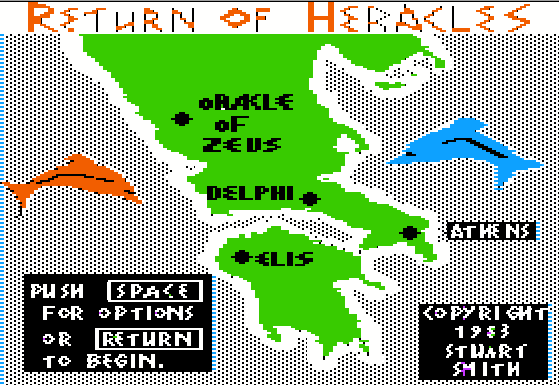
Video Game Review: The Return of Heracles (1983)

In the halcyon days of the 1980s, there were few computer roleplaying games (CRPGs) that weren't derivative of Tolkien and/or Dungeons & Dragons.  Fewer still sought to provide any kind of educational value for their players.  One of few CRPGs that excelled in both areas was The Return of Heracles by Stuart Smith.


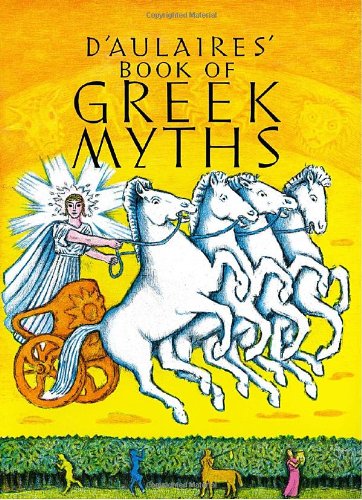
Set in Bronze Age Greece and based on some the most famous tales from Greek mythology, in The Return of Heracles the player(s) assume control of one or more legendary or historical heroes, including Achilles, Jason, and mighty Heracles! Tales of these mighty men and women (and animals) have thrilled audiences for millennia, including myself.  In grade school, I read the fantastic D'Aulaires' Book of Greek Myths many, many, many times at the local library.


In order to win the game, the player(s) must complete a dozen tasks which, as one might expect from the title, are drawn mostly from the Labors of Heracles, but also include other classics from Greek mythology, such as solving the Riddle of the Sphinx and retrieving the Golden Fleece.  Upon completion, the player receives points (with bonus for speed) and usually gets an in-game treasure, buff or other reward as well.


The game mechanic is simple but straightforward and adds to the breezy fun.  The soundtrack, though technologically an artifact of its day, is apt and evocative.  And, the open sandbox design of the game world avoids railroading, a common problem for many CRPGs even to the present day.


Messr Smith's humor and cleverness are evident throughout The Return of Heracles.  There are 250 NPCs with individual stats, factions and motivations, such as Inebriated Thief and Not-very-smart Thief.   And just walking through a door can be hazardous!


Original, colorful and full of obvious admiration of the source material, this game is a masterwork.  If you're a lover of Sword & Sandal or Greek mythology, The Return of Heracles is perhaps the best CRPG of the era and even if you only have a passing interest, it's worth a look.  So strap on your greaves and hark back to a time when gods and monsters roamed the land.

But do avoid giving an obolus to Charon.

SC's Parting Shot: 10 of 10

Thursday, February 26, 2015

Meta Review: Chess.com's Everything You Need to Know About Chess (2011)

I wanted to give a shout out to the best and most concise review of Chess that I've ever seen, Everything You Need to Know About Chess.  Created and narrated by International Master Daniel Rensch for Chess.com, this video series does the seemingly impossible: pare the essential knowledge about the Game of Kings down to less than an hour!  That the series also pulls off this herculean task in a clear, fun and engaging manner is the cherry on top.


Considered by many to be the finest and most respected strategy game of all time, the modern version of Chess is believed to have originated in 6th century India.  In the millennia since, the Game of Kings has been played, debated and dissected by leaders of all stripes, scholars and enthusiasts.  As you might expect, the game has a rich history filled with colorful figures, such as Paul Morphy and Bobby Fischer, and moments of true genius.


Aimed at 90 percent of players, Everything You Need to Know About Chess does assume that you have the bare minimum knowledge to play (i.e., you know how each piece moves, you know the relative value of each piece, you know how to castle, etc.), but then it provides a staggering amount of strategy, tactics, guiding principles and background information in a short period of time that lets you approach the game in a more systematic and enlightened manner.  Produced by the fine folks at Chess.com, the world's most frequently visited chess website, Everything You Need to Know About Chess is broken up into several parts: The Opening, Tactics & Strategy, The Endgame, as well a couple of summary and supplemental videos.  This meta review highlights the first three videos:

  • The Opening


This video stresses the importance of development, center control and other principles that are key to strong openings.


  • Tactics & Strategy


This video covers the most fundamental tactical patterns: forks, pins and skewers.  It also covers pawn structures and key types of checkmates.


  • The Endgame


This video highlights king activity and pawn play.


In terms of return on time invested, I don't know that you'll find a better deal than Everything You Need to Know About Chess.  If you can absorb and effectively utilize the information in just the three videos above, for most people, your game should improve by at least a level.  In addition, the series also provides a great springboard for further study of chess theory.

Game on!

SC's Parting Shot: 10 of 10

Thursday, February 12, 2015

Movie Review: The Last Unicorn (1982)

I wanted to give some love to a wonderful but somewhat forgotten classic animated film, The Last Unicorn:


Adapted from the novel with a screenplay by the original author, The Last Unicorn follows the title character as she leaves the safety of her forest to discover what happened to her people.  Through various twists and turns, the Unicorn learns more about herself and the wider world than she thought possible or that she bargained for, and the ending is both bittersweet and something of a surprise.

Although ostensibly a children's film, The Last Unicorn is, in fact, a far more mature and richly layered narrative that is, by turns, a coming of age story, a mystery, a romance and a stirring tale of heroism.  This movie is a fairy tale, but it's more in the mold of the Brothers Grimm.  For example, there are moments filled with sorrow and bitterness that you'll never see in a Disney film, such as Molly Grue's lament upon meeting the Unicorn:
Molly: No, it can't be! Can it be? Where have you been? Where have you been? Damn you! Where have you been? 
Schmendrick: Don't you talk to her that way! 
Unicorn: I'm here now. 
Molly: And where were you twenty years ago? Ten years ago? Where were you when I was new? When I was one of those innocent young maidens you always come to? How dare you! How dare you come to me now, when I am THIS?! [Weeps]


Moving stuff.

The film also isn't afraid to bring the dark, such as when the Harpy kills Mommy Fortuna by ripping off the latter's face:


You'll never see THAT in a Disney film, either.

From top to bottom, this is a fantastic film.  Produced by Rankin/Bass, the guys that made the iconic animated versions of J. R. R. Tolkien's The Hobbit and The Return of the King, the animation in The Last Unicorn is stylistically similar but qualitatively superior to those other films, which is unsurprising since it was done by Topcraft, a company that was bought out of bankruptcy by its top flight talent and turned into Studio Ghibli.


The movie also boasts an all-star vocal cast, including Mia Farrow, Jeff Bridges, Alan Arkin and, Saruman himself, Christopher Lee, who are all excellent, bringing depth and distinct personalities to their roles.  Furthermore, the mellow but melancholy soundtrack, performed by America, fits perfectly.

Like all the best "Young Adult" fiction, The Last Unicorn always treats its audience with intelligence and respect.  It is unafraid to ask tough questions and demand tough answers.  For example, the Unicorn learns that the world can be hard and unfair, even if or, indeed, because you've done the right thing.

I recommend this movie not only to speculative fiction fans but anyone who likes challenging, engaging and though provoking media.

SC's Parting Shot: 10 of 10

Thursday, January 8, 2015

Movie Review: Ninja Scroll (1993)

I wanted to give a shout out to my favorite animated film of all time, Ninja Scroll:


Better known in its native Japan as "獣兵衛忍風帖," Ninja Scroll is a stunning accomplishment.  Visually breathtaking, with a dark, twisted mystery and a tough-as-nails protagonist that would make Raymond Chandler proud and filled with explosive action, rich details, a wry sense of humor and interesting characters, this is a great story.  Full stop.

The plot follows wandering adventurer Kimagabei Jubei (牙神 獣兵衛), as he inadvertently becomes embroiled in a plot by an old enemy that will determine the fate of Japan.  Ninja Scroll has ninjas, samurai, super spies, demons, dark sorcery, and even pirates (sort of).  The only thing it doesn't have is a scroll.


As far as I can tell, that's the ONLY problem with Ninja Scroll.  Blending fiction and historical fact, the film is set in a well realized Fantasy Japan that's logical and internally consistent.  This logical bent extends to the superb character design, where the characters' skills and abilities make internal sense, are consistent, and sometimes take the story in unexpected directions.  Furthermore, the characters' flaws and foibles make them three-dimensional and relatable and also take the story in unexpected directions as well.

Writer/Director Kawajiri Yoshiaki's (川尻 善昭) attention to detail is outstanding and pays off in really inventive ways, such as the wire connected to Jubei's sword.


Also, the various plots within plots would make Frank Herbert proud.

Even if characters and the story were dumb (which, thankfully, is not the case), the fight scenes themselves are worth the price of admission.  As Jubei and his unexpected companions, Kagero and Dakuan, battle the Eight Devils of Kimon (鬼門八人衆), combat features gory splatterfests, chess-like strategy, clever misdirection and just about everything in between.  Jubei may be  a master swordsman and ninja, but the Devils of Kimon have him clearly outgunned and our reluctant hero only manages to triumph through various combinations of trickery, teamwork and luck.  Fight choreography is uniformly excellent.

As fair warning, Ninja Scroll does feature more than a little graphic sexual content, but such is part of the story and never simply for the cheesecake factor.  Personally, I think it adds to the sense of this bold, no-holds barred style of storytelling.


I've loved this movie to bits ever since it was released on VHS.  And the quality of the art and the story is such that it still holds up well after more than two decades.  Truly a masterwork.

SC's Parting Shot: 10 of 10

Sunday, September 7, 2014

Meta Review: Heir's Faction Focus


I'm calling this a "Meta Review," since it's my $0.02 on Heir of Carthage's review of the playable factions in Total War: Rome II.


In terms of Total War: Rome II itself, I think it's a fun and great looking game: actually, the visuals are one of the inspirations for my homebrew Olde School Dungeons & Dragons, and part of the reason that I shifted the campaign setting from medieval to iron age.  Another thing that I like about the game is the ability for players to use some real tactics, such as Hammer and Anvil strikes.

While there are many folks doing video commentaries of Total War: Rome II, I particularly like Heir of Carthage's body of work because he is quite humble (he freely admits that he's not the best player, though he is still quite skilled).    Here is a review, of the Nervii, where he does a good job of reacting quickly to a changing situation:


Though Heir's Nervii army build was intended to be defensive, when he sees an opportunity, he pushes his infantry forward.  Then, after getting his light cavalry around the flank to slow down the  retreating enemy infantry, Heir is able to destroy his opponent's center in detail.

Another big point is the learning aspect for the viewer: Messr Heir takes the time to explain what he's doing and why, and what he could have done better.  Moreover, he also freely points out where he makes other mistakes and he's not afraid to experiment with unconventional army builds for fun.

Another thing that I really like is how Heir is gracious in both victory and defeat, as you can see here where he plays as the Selecuids against Egypt:


In terms of Heir's review of the factions, Messr Heir has a pretty thorough knowledge of the stats, capabilities and relative economic costs of the various unit types and he goes through the ins-and-outs of each unit of each faction, doing a pretty comphrensive job for each faction.  After a quick battle where he attempts to illustrate these points, he also does a rundown of the faction's relative advantages and disadvantages vis-à-vis the other factions.

So, I think watching Heir's Faction Focus might be helpful to someone who already has a basic knowledge of Total War: Rome II and who wants some advanced knowledge and a quick but fairly comprehensive rundown of a  specific faction.

SC's Parting Shot: 10 of 10