Somewhat forgotten nowadays, the chariot was the first great weapons platform, remaining king of the battlefield for over a millenia:
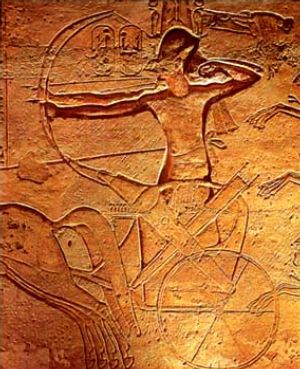 |
| Pharaoh Ramses II at the Battle of Kadesh |
The chariot was an evolutionary development from earlier animal drawn vehicles such as wagons and carts. They served first as mobile archery platforms and later, with the development of scythed chariots, on the charge they were able to deliver devastating shock attacks. The chariot's speed and mobility were game changing and Maneuver Warfare became possible for the first time.
As you might expect, the history of the chariot is intimately tied to that of the horse. Since an increasing amount of evidence supports the hypothesis that horses were domesticated in the Eurasian Steppes during approximately 4000–3500 BC, it is unsurprising that the first true chariots were probably invented near the Ural Mountains around 2000 BC:

The steppe nomads likely used their new war machines for raids against other peoples, leading to the widespread dissemination and adoption of this new technology from China to Britain.
Coming at a time in the horse's domestication prior to the possibility of cavalry, these war machines were nevertheless able to harness equine speed and agility with the help of several Bronze Age inventions, including the invention of lighter spoked wheels. The chariot was a single axle carriage drawn by a team of one or more horses. The crew consisted of two or three people: a driver, an archer/commander and sometimes a spearman/shieldman.

Another Bronze Age invention, the compound bow, helped the chariot to dominate battlefields by being able to deliver armor-piercing strikes up to 100 meters away and killing shots against unarmored foes up to 300 meters away. Since the chariot provided the compound bow with a swift, agile, stable and raised firing platform, it was a marriage made in Hades.
The cost of the horses and the chariot were prohibitive to all but nobility and royalty, and unsurprisingly the chariot became a symbol of power and status.

With the further domestication of the horse, the chariot was eventually superseded by cavalry around the 5th century BC, although the Celts continued to use them into the 1st century AD. Nevertheless, the first great weapons platform's influence was profound and can be felt to the present day from the latest combination of mobility and firepower dominating warfare, the Main Battle Tank.

As you might expect, the history of the chariot is intimately tied to that of the horse. Since an increasing amount of evidence supports the hypothesis that horses were domesticated in the Eurasian Steppes during approximately 4000–3500 BC, it is unsurprising that the first true chariots were probably invented near the Ural Mountains around 2000 BC:

The steppe nomads likely used their new war machines for raids against other peoples, leading to the widespread dissemination and adoption of this new technology from China to Britain.
Coming at a time in the horse's domestication prior to the possibility of cavalry, these war machines were nevertheless able to harness equine speed and agility with the help of several Bronze Age inventions, including the invention of lighter spoked wheels. The chariot was a single axle carriage drawn by a team of one or more horses. The crew consisted of two or three people: a driver, an archer/commander and sometimes a spearman/shieldman.
Another Bronze Age invention, the compound bow, helped the chariot to dominate battlefields by being able to deliver armor-piercing strikes up to 100 meters away and killing shots against unarmored foes up to 300 meters away. Since the chariot provided the compound bow with a swift, agile, stable and raised firing platform, it was a marriage made in Hades.
The cost of the horses and the chariot were prohibitive to all but nobility and royalty, and unsurprisingly the chariot became a symbol of power and status.

With the further domestication of the horse, the chariot was eventually superseded by cavalry around the 5th century BC, although the Celts continued to use them into the 1st century AD. Nevertheless, the first great weapons platform's influence was profound and can be felt to the present day from the latest combination of mobility and firepower dominating warfare, the Main Battle Tank.